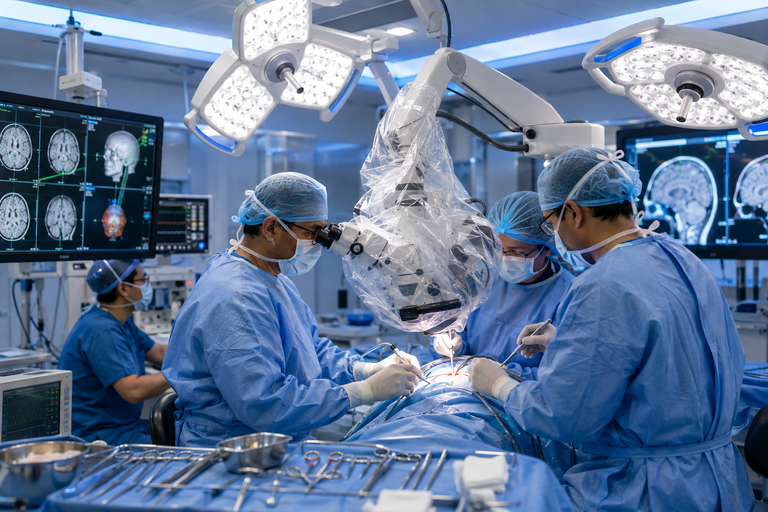
Neurosurgery requires the highest level of surgical precision, infrastructure, and post-operative care. Sultan GHC partners exclusively with JCI-accredited hospitals where internationally trained neurosurgeons perform hundreds of cranial and spine procedures each year — at a fraction of American hospital costs.
Neurosurgery vs Neurology: Neurosurgeons perform operative procedures on the brain, spine, and peripheral nerves. If you are seeking non-surgical medical management of neurological conditions such as Parkinson’s, MS, epilepsy, or stroke recovery, visit our Neurology page →
Our partner hospitals manage the full spectrum of brain, spine, and peripheral nerve surgical conditions — from common herniated discs to complex brain tumor resections.
From minimally invasive spine surgery to complex open craniotomy — partner hospitals deliver every neurosurgical procedure with international-standard protocols, implants, and post-operative monitoring.
Open and minimally invasive craniotomy for the surgical resection of gliomas, meningiomas, metastatic brain tumors, and other intracranial lesions — performed with intraoperative MRI (iMRI) and neuronavigation at select partner hospitals.
Non-invasive stereotactic radiosurgery delivering focused radiation to brain tumors, AVMs, trigeminal neuralgia, and acoustic neuromas — without a surgical incision. No general anesthesia. Day procedure in most cases.
Both microsurgical clipping (open craniotomy) and endovascular coiling (minimally invasive, catheter-based) are available for unruptured and ruptured cerebral aneurysms — matched to aneurysm anatomy and patient risk profile.
Minimally invasive endoscopic transsphenoidal surgery to remove pituitary adenomas through the nasal passage — no external incision, shorter hospital stay (2–4 days), and faster recovery than traditional open craniotomy.
Arteriovenous malformation (AVM) management combining endovascular embolization, microsurgical resection, and/or stereotactic radiosurgery — determined by AVM grade (Spetzler-Martin) and patient risk factors.
Ventriculoperitoneal (VP) shunt implantation for the treatment of hydrocephalus — both programmable valve shunts and endoscopic third ventriculostomy (ETV) are available as indicated.
Microdiscectomy, laminectomy, foraminotomy, and spinal fusion using minimally invasive techniques — smaller incisions, reduced blood loss, shorter hospital stays, and faster return to activity compared to open spine surgery.
Surgical implantation of Medtronic or Abbott DBS electrode systems for Parkinson's disease, essential tremor, and dystonia — performed by neurosurgeons and movement disorder neurologists working as an integrated team. Post-surgical programming included.
Microsurgical decompression of cranial nerves — the standard surgical treatment for trigeminal neuralgia (TN), hemifacial spasm, and glossopharyngeal neuralgia. High success rate for appropriately selected candidates.
Surgical resection of epileptic foci for drug-resistant focal epilepsy — including temporal lobectomy, lesionectomy, corpus callosotomy, and SEEG-guided resective surgery following thorough pre-surgical evaluation.
Have MRI or CT scans? Submit them for a free surgical opinion.
Upload Reports & Get Free Surgical ReviewAll figures represent approximate self-pay costs. U.S. figures sourced from FAIR Health Consumer, CMS Hospital Price Transparency data, and published hospital pricing. India and Türkiye figures from JCI-accredited partner hospital published rates (2025).
| Procedure |  USA — Self-Pay USA — Self-Pay |  India India |  Türkiye Türkiye |
|---|---|---|---|
| Craniotomy (Brain Tumor Removal) | $100,000–$300,000 | $8,000–$18,000 | $12,000–$25,000 |
| Endoscopic Pituitary Surgery | $50,000–$120,000 | $6,000–$15,000 | $9,000–$20,000 |
| Cerebral Aneurysm Clipping | $60,000–$150,000 | $8,000–$18,000 | $10,000–$22,000 |
| Cerebral Aneurysm Coiling (endovascular) | $40,000–$100,000 | $6,000–$14,000 | $8,000–$18,000 |
| Gamma Knife Radiosurgery | $20,000–$50,000 | $4,000–$10,000 | $6,000–$14,000 |
| AVM Embolization | $40,000–$100,000 | $7,000–$15,000 | $9,000–$20,000 |
| VP Shunt (Hydrocephalus) | $30,000–$80,000 | $4,000–$9,000 | $6,000–$12,000 |
| MISS — Microdiscectomy / Laminectomy | $50,000–$120,000 | $5,000–$12,000 | $7,000–$16,000 |
| Deep Brain Stimulation (DBS) | $80,000–$150,000 | $15,000–$28,000 | $20,000–$35,000 |
| Microvascular Decompression (MVD) | $30,000–$80,000 | $5,000–$12,000 | $7,000–$15,000 |
Costs are indicative for self-pay patients. Actual costs vary by tumor grade, surgical complexity, ICU days, and implant selection. See full India cost savings → · Türkiye cost savings →
85–92%
Average Saving in India
vs U.S. self-pay neurosurgery
75–88%
Average Saving in Türkiye
vs U.S. self-pay neurosurgery
24–48 hrs
Free Surgical Opinion
submit MRI, get written review

Apollo, Fortis, Medanta, Rela Institute, AIIMS-affiliated centers

Acibadem, Memorial, Koc University Hospital
Brain and spine surgery carries inherent risk in any country. Sultan GHC does not guarantee surgical outcomes. Our role is to match you with experienced, credentialed surgeons at accredited institutions, help you understand your options, coordinate logistics, and support you through every step of your journey. We strongly encourage a second surgical opinion before any neurosurgical procedure. All treatment decisions are made by you and your surgical team.
Upload your MRI with contrast, CT scans, biopsy reports, or clinical notes. A senior neurosurgeon from our network will review your case and provide a written recommendation within 24–48 hours — at no cost, no obligation.
Medical management of stroke, Parkinson's, epilepsy, MS, and movement disorders
Brain tumor oncology, radiation therapy, and chemotherapy — for medical management of neuro-oncology cases
Orthopaedic approach to cervical/lumbar disc disease, scoliosis, and sports-related spinal injury
Robotic-assisted spine surgery and minimally invasive neurosurgical techniques
For carotid artery disease and cerebrovascular conditions requiring vascular intervention
Every hospital is individually vetted for international accreditation, specialist credentials, and patient outcome standards before Sultan GHC refers a single patient.


India
Gurugram, Delhi NCR · 1,600+ Beds

India
Chennai · 400+ Beds

India
Chennai & Pan-India · 10,000+ Beds

India
Gurugram, Delhi NCR · 310 Beds


Türkiye
Istanbul · 200+ Beds

Türkiye
Istanbul & Ankara · 300+ Beds

Türkiye
Istanbul · 400+ Beds
Sourced from real patient questions handled by Sultan GHC's medical and patient care team.
Craniotomy in the U.S. typically costs $100,000–$300,000. At a JCI-accredited hospital in India, the same procedure costs $8,000–$18,000 — a saving of over 90%. Türkiye costs $12,000–$25,000. Sultan GHC provides a personalised estimate within 24 hours based on your MRI and surgical plan, at no charge.
Safety is determined by surgeon experience, hospital infrastructure, and ICU capability — not location. Our partner JCI hospitals have intraoperative MRI (iMRI), neuronavigation, neurophysiology monitoring, and Level-1 NeuroICUs. Neurosurgeons perform 500–1,500 cranial and spine operations annually and hold international qualifications including FRCS (Neurosurgery) and EANS fellowships.
Gamma Knife is a non-invasive procedure that delivers focused radiation to destroy brain tumors or AVMs without a surgical incision. Available at Apollo, Fortis, and Rela Institute partner hospitals in India, and at Acibadem and Memorial Hospital Istanbul. India cost: $4,000–$10,000 vs $20,000–$50,000 in the U.S.
Most craniotomy patients need 14–21 days in-country: 2–3 days pre-surgical evaluation, 1–2 days pre-op admission, 2–4 days NeuroICU, 5–7 days general ward, then a final surgical review before flying clearance. Minimally invasive spine procedures may allow discharge in 5–10 days.
Yes — and it is strongly recommended for brain surgery. Sultan GHC arranges a complimentary remote second opinion from a senior neurosurgeon within 24–48 hours. Upload your MRI with contrast, CT scans, biopsy reports, and current medications. The neurosurgeon provides a written recommendation including surgical approach, implant choices, and recovery expectations. No cost, no obligation.
Many of our partner neurosurgeons trained at Johns Hopkins, Cleveland Clinic, Mayo Clinic, Karolinska Institute, and UK NHS neurosurgery centers. They hold FRCS (Neurosurgery) or MCh Neurosurgery credentials and work in JCIA-accredited hospitals with the same international clinical protocols. Volume is high — 400–1,500 neurosurgical cases per surgeon per year.
Have a question not listed here? Visit our full FAQ → or contact our Patient Care team.
Upload your MRI with contrast, CT scans, or surgical referral letter. Our medical team connects you with a senior neurosurgeon from our JCI-accredited network within 24–48 hours.